
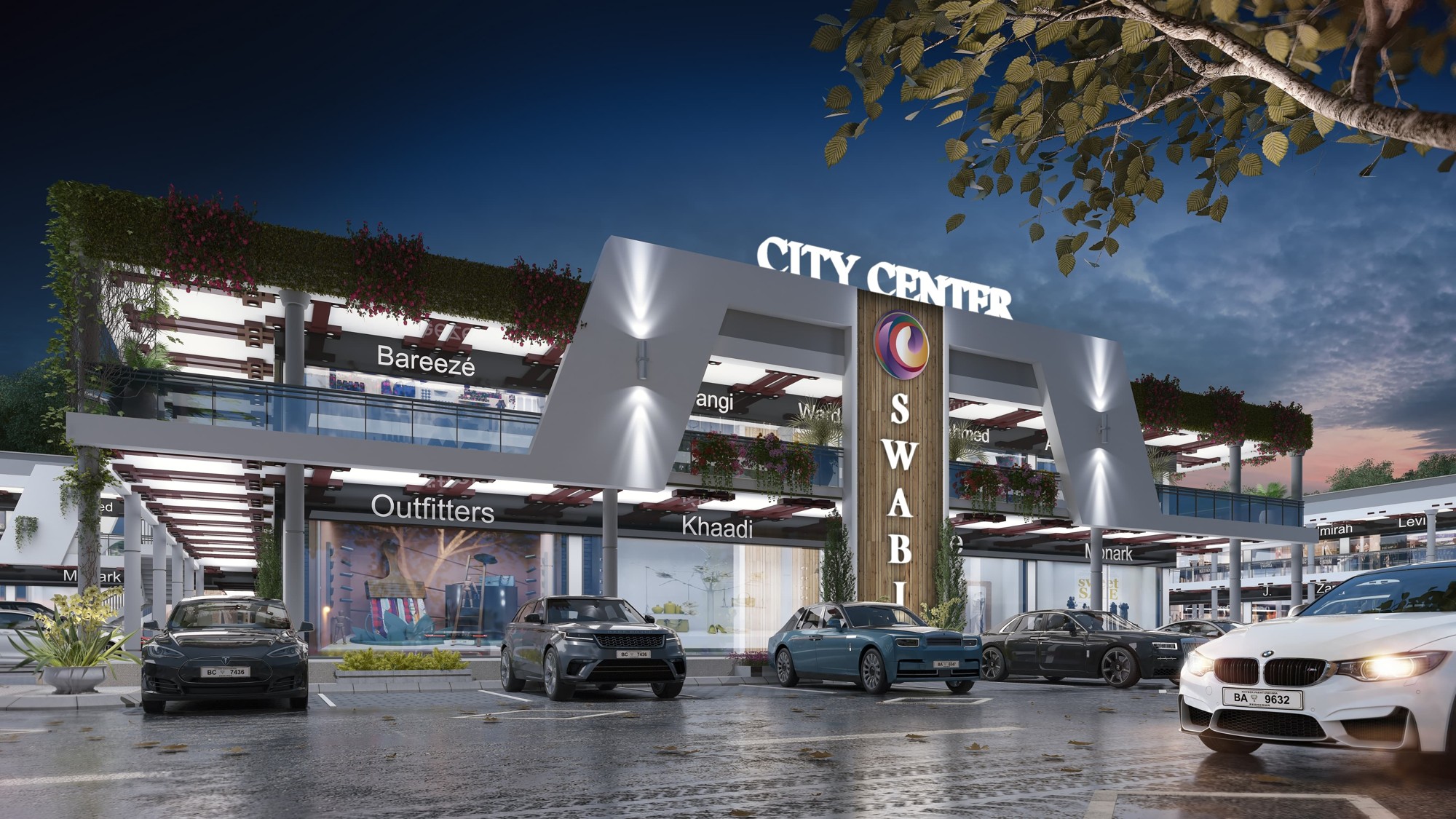
City Centre Swabi was, until 2025, an 80-shop retail plaza only on paper. Today it is the most visible MCC project on the Swabi bazaar corridor — fully operational, fully leased, and structurally over-engineered for at least the next 50 years. Here is the build, in the order we approached it.
The brief. Anchor a high-traffic commercial corridor with a structure that would deliver retail efficiency in the short term and structural resilience in the long term. Two floors. 80 retail units. A constrained urban footprint. Self-developed end-to-end by MCC — site identification, build, and ongoing operation.
The first hard problem: column placement vs. leasing strategy. A retail plaza either lays out its column grid first and forces the leasing strategy around it, or it works the other way. The cheaper way is the first. The right way is the second. We started with the leasing model — what shop sizes was the bazaar actually demanding, where would the natural circulation routes form, where would the anchor units sit — and then commissioned a structural frame designed around it. That is the only way to get 80 economic shop bays out of two floors without one out of every five units being structurally compromised.
The structural design that came back gave every shop equal exposure to a primary circulation axis. No single shop was more than 8 metres from a main aisle. No shop bay was less than the minimum economic depth. The structural model accepted slightly higher loading on the perimeter columns to free the interior — a deliberate trade-off, sized correctly.
The second hard problem: foundations. The Swabi bazaar corridor sits on mixed sub-grade, and a retail plaza is unforgiving — heavy continuous live loading from fit-out, storage, and foot traffic, with shops above each other on the upper floor. We over-engineered the foundation deliberately, beyond the minimum the structural calculations demanded. The cost addition at the foundation stage was perhaps 8% of total. The risk reduction was an order of magnitude larger.
The third problem: material verification. This is where most contractors quietly cut margins, and where every long-term failure originates. We logged every batch of concrete by date, supplier, and slump test result. We logged every consignment of steel by mill certificate and on-site weight check. The unseen quality matches the visible finish — that's not a tagline, it's an audit trail. Any structural element built into MCC's plaza can be traced back to the day its concrete was poured and the certificate that came with the steel that reinforced it.
The fourth: circulation and services routing. A two-floor plaza that gets the staircases and services routing wrong loses half its retail value before opening day. We routed services (water, electrical, drainage) up the perimeter spine so no shop had a vertical service riser landing in the middle of its retail floor. Staircases were placed at the natural inflection points of customer flow — not at the corners, where most plazas put them, where they become dead zones.
The fifth: turn-key fit-out vs. tenant-led fit-out. We deliberately delivered shells, not finished interiors. Tenants finish their own fit-out, which gives them flexibility and gives us a cleaner handover. What we did finish was every common element to a finished standard — facade, lobby, common circulation, signage. The plaza opens looking finished even when individual tenants are still fitting out.
The outcome. 80 retail units, all leased, trading since 2025. The plaza is now the dominant commercial anchor on its stretch of the bazaar. We continue to operate it.
What we'd do differently. Honest answer: we'd build slightly more vertical service shafts. Two-floor retail is forgiving, but we already see scope for a third floor at some point — and that's when extra service capacity at the foundation and routing stage pays back. Not a regret, but a lesson logged for the next plaza.
The repeatable lesson. A retail plaza is only as successful as its leasing strategy and only as enduring as its structural design. Get either wrong and the project under-performs. Get both right — and refuse to compromise on material verification — and you get a structure that anchors a corridor for a generation.